

In my last post, we looked at the “Harness”—the infrastructure that connects an LLM to your data and tools. But there is a massive shift happening right now: the move from Linear Workflows to Autonomous Agents.
The difference is highlighted by that blue hand-drawn circle in the diagram: The Agent Loop.
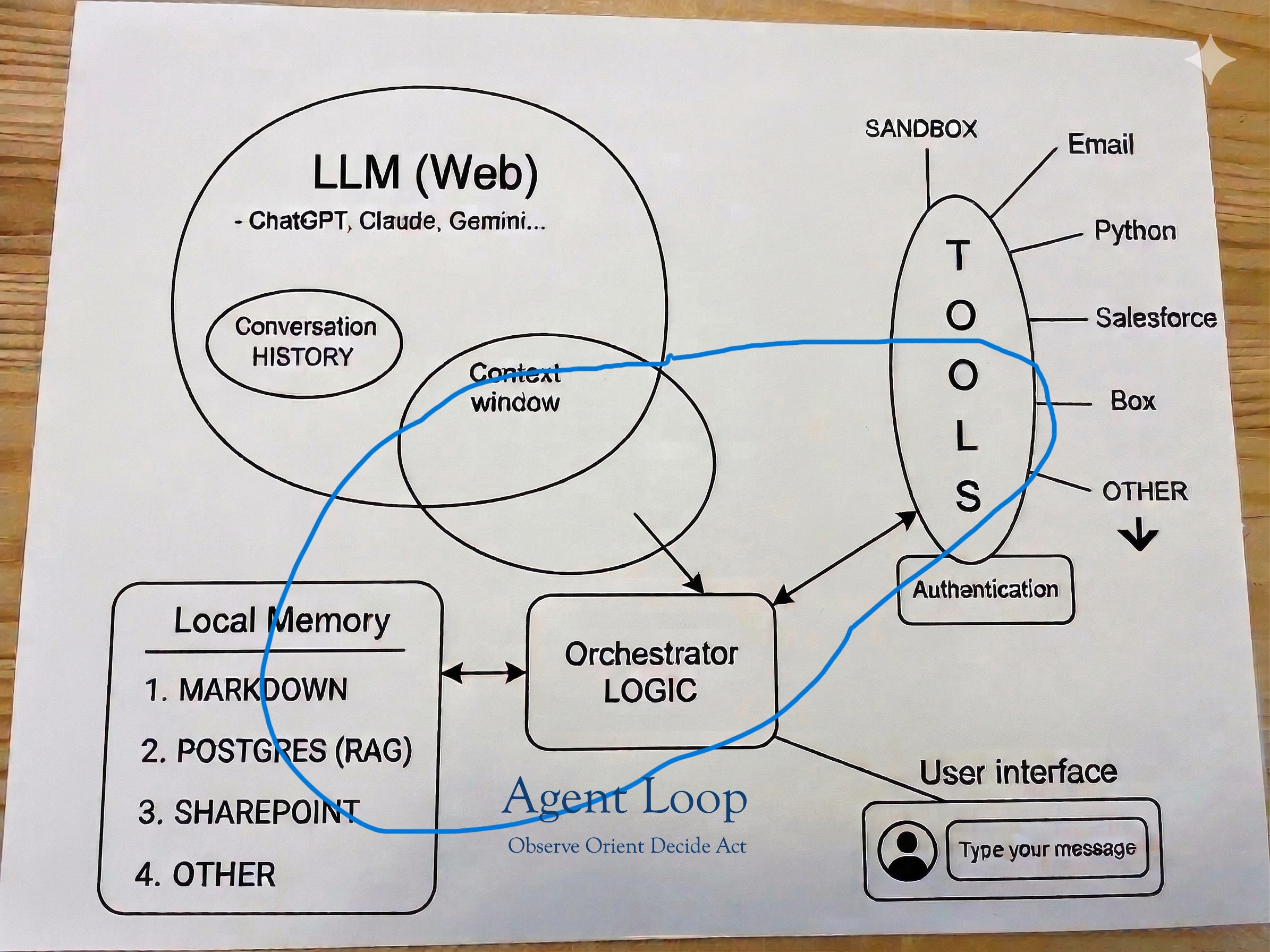
Observe, Orient, Decide, Act (OODA)
A standard AI setup waits for you to tell it exactly what to do. An Agent, however, lives in a continuous loop. It doesn’t just execute a command; it pursues a goal.
Observe: The agent looks at the current state (the Context Window + Local Memory).
Orient: It evaluates that information against the goal you set.
Decide: It chooses which Tool (Email, Python, Box) is needed next.
Act: It executes the tool, sees the result, and starts the loop over again.
Why the “Loop” Changes Everything
Notice how the blue circle encompasses Memory, Logic, and Tools. In a basic setup, if the AI runs a Python script and gets an error, it stops and asks you what to do. In an Agentic Loop, the Orchestrator sees the error, “observes” that the task isn’t done, and “decides” to try a different approach or fix the code itself.
The “Harness” provides the connection, but the “Loop” provides the autonomy.
What’s Next? We are moving away from “Human-in-the-middle” to “Human-on-the-edge.” You set the intent, and the Agentic Loop manages the execution. In the coming weeks at SkippingRockAI, we’ll dive deeper into how we’re building these “agentic harnesses” for real-world infrastructure.